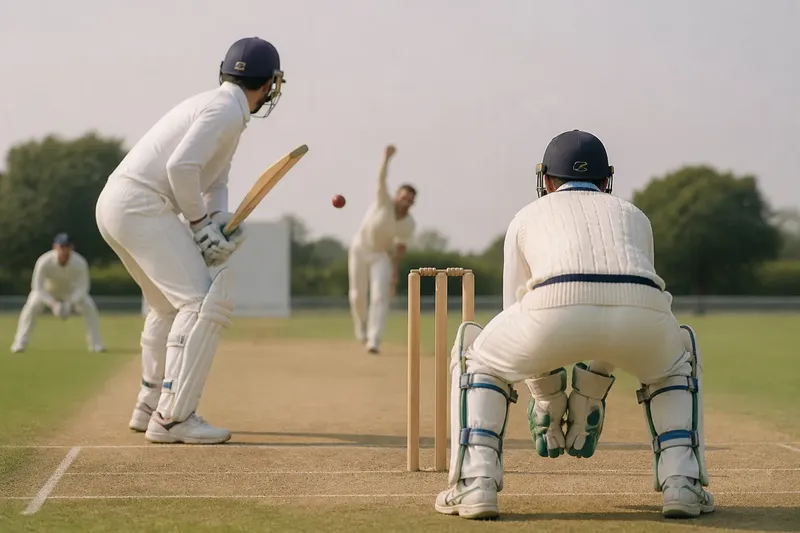
Cricket Over Rules: Why Six Legal Balls Can Take Longer
Cricket over rules explain how wides, no-balls, and dead balls affect the legal-ball count, so you can follow an over and read its scoreboard accurately.
The most common mistake in reading an over is counting six attempts as six completed balls. It can make the score display seem wrong and leave you unsure why the bowler is still bowling. Cricket over rules count legal deliveries, not every ball-shaped event.
An over is generally complete after six legal deliveries, subject to the applicable laws and playing conditions. A wide or no-ball does not count toward those six, so the bowler must deliver again. The umpire’s call determines how that event is recorded.
The legal-ball count
Think of an over as a row of six boxes: a legal delivery fills a box, while a non-counting delivery leaves it open. The ball might be played, missed, or hit to the boundary, but those outcomes do not by themselves determine whether it counts.
Runs and legal-ball status are separate matters. A legal delivery can produce no runs, several runs, or a wicket; a wide or no-ball can also lead to scoring or a dismissal permitted by the laws. The scorer records both what happened and whether the delivery advanced the over.
That distinction is why an over can involve more than six deliveries without containing more than six legal balls. The bowler’s over count follows legal deliveries, while extras are recorded separately from runs credited to a batter.
Wides and no-balls
A wide is judged under the applicable laws and playing conditions, including whether the batter could reach the ball and play it with a normal cricket stroke. The umpire considers the batter’s position and movement, as well as the relevant conditions; it is not simply a fixed-distance test. The decision is made for that delivery in its circumstances.
A no-ball has different grounds. Common causes include an illegal front-foot landing or a delivery prohibited as dangerous under the applicable rules. The precise provisions can vary by competition, but a no-ball does not count among the six legal deliveries.
Both calls usually add an extra to the batting side, and other runs may also be scored. The way those runs are attributed depends on the type of extra and what happened. Wide and no-ball are not interchangeable: the possible dismissals and other consequences differ.
Reading the score display
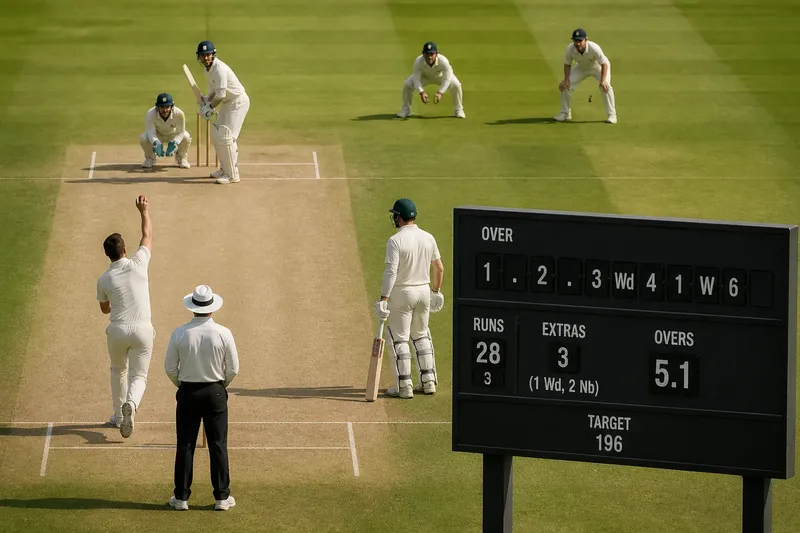
A scoreboard may show an over as symbols and figures. A dot commonly represents a legal delivery with no run recorded from the bat or as an extra; labels such as “Wd” and “Nb” indicate wides and no-balls. Display conventions vary, so follow the legal-ball count rather than assuming every mark represents one of the six balls.
Some displays attach an extra to the runs from the same event; others present a compact sequence. A wide or no-ball can appear in the record without occupying one of the six legal-ball positions, which is why the sequence may contain more than six entries.
Say an over begins with two legal dot balls, then a wide, followed by three legal deliveries that produce one run, a wicket, and no run. The bowler has completed five legal balls: two before the wide and three after it. The wide adds to the score but does not fill the sixth box, so one more legal delivery is needed.
If that next attempt is another wide, the over remains unfinished. The count advances only when a legal delivery is bowled; the extra and the delivery count answer different questions.
Other non-counting events
Not every delivery that fails to advance the count is a wide or no-ball. A dead-ball call or an interruption can affect whether a delivery counts, depending on the circumstances and the applicable law. The umpire’s decision determines the record.
A delivery can also count even if it travels only a short distance or the batter does not attempt a shot, provided it is valid and no relevant call prevents it from counting. Legal status is a ruling, not a measure of how much happened during the ball.
Questions about overs?
These common questions clarify how the legal-ball count works in ordinary scorekeeping. Competition rules can affect details, so the umpire’s decision and playing conditions remain authoritative.
Does a wide count as one of six balls?
No. A wide does not advance the legal-ball count, so another delivery is needed to complete the over. It normally adds an extra, with other scoring consequences depending on what happened.
Does a no-ball count as one of six balls?
No. A no-ball is excluded from the six-ball count, even if the batter hits it or runs are scored. Its effects on dismissals and a possible free hit depend on the applicable laws and playing conditions.
Can a batter be out from a wide or no-ball?
Yes, but only by forms of dismissal allowed for that call. A wide can permit dismissals such as stumping or run out, while a no-ball prevents several common forms, including bowled and caught. The precise circumstances matter.
Does every over contain exactly six deliveries?
An over generally contains six legal deliveries, but it can take more than six attempts to bowl them. Wides, no-balls, and other events that do not count can extend the sequence.
Scoring and consequences
An illegal delivery affects more than the team total: it can add an extra, leave the over incomplete, and give the batting side another opportunity. The next delivery usually remains part of the same over unless a rule or interruption changes the sequence.
Extras are not credited to a batter in the same way as runs made from the bat. Completed runs and boundary runs may have their own scoring treatment, so the team total can rise without an equivalent increase in a batter’s personal score.
In many limited-overs competitions, a no-ball can lead to a free hit under the playing conditions. The free-hit delivery still has to be assessed for legality: if it is another wide or no-ball, it does not complete a legal ball of the over.
For any uncertain call, use the competition’s playing conditions and the umpire’s ruling rather than inferring a result from the display alone. Cricket over rules are easiest to follow when you track legal deliveries separately from runs and extras.