From Timeless Matches to Limited Overs: Cricket’s Changing Clock
Cricket’s changing clock shapes declarations, draws, and limited-overs tactics. Learn what to watch in the score, schedule, overs, and revised targets.

The common mistake is to treat a scheduled finish as a simple boundary around cricket; it can cost you sight of how deeply time shapes each decision. Cricket’s changing clock is easiest to understand by watching what a team must protect: in one format, a wicket may be worth more than a quiet hour; in another, an unused over is an opportunity that disappears for good.
Time as an open horizon
Some historic matches were designated timeless, meaning they were not scheduled to finish after a fixed number of days. That did not mean play could continue without limit: weather, light, travel, local arrangements, and other practical constraints shaped how long a match could actually go on. Conditions and conventions varied, so the label describes a format rather than a promise that every contest continued until a result.
The open schedule favored patience and endurance. A batting side could try to survive a dangerous spell and rebuild; a bowling side could keep applying pressure without watching a fixed daily allocation of overs run out. Even so, the match’s prospects depended on circumstances beyond the scorecard.
Timed multi-day cricket makes the calendar part of the contest. A match can end drawn when scheduled play expires without a result, so a side ahead on the field still has to consider whether enough time remains to finish the job. A lead matters, but so does the time available to turn it into a win.
Declarations and the clock
Declarations show the timed game’s central bargain. A captain can close an innings voluntarily, giving up the chance to add runs in exchange for more time to dismiss the opposition. Declaring too early may leave a target within reach; declaring too late may leave too little time to take the wickets needed for victory.
Imagine a side batting late in a multi-day match with a substantial lead while the opposition still has wickets in hand. Its captain declares rather than extending the innings, leaving the other team a target and time to bat. The observable change is immediate: the match shifts from accumulating runs to balancing survival against a chase, and the bowlers now have a defined task.
For a reader, the useful question is not simply “Who is ahead?” Ask instead: how many innings remain, what result can each side still reach, and how much scheduled play is left? A score becomes more legible when read alongside the clock.
Overs become a budget
Limited-overs cricket makes the time boundary more visible by allocating each innings a fixed number of overs. An over is a group of legal balls bowled by one bowler from one end; after it, another bowler takes over from the opposite end. The innings ends when its overs are used, the batting side loses its available wickets, or another playing condition ends it earlier.
That limit turns an over into a perishable resource. A batter who refuses a risky scoring chance may preserve a wicket, but cannot carry an unused over into the next innings. Conversely, a boundary can improve the scoring rate, yet taking needless risks can leave fewer batters available for the closing overs.
Think of the overs as a row of tickets: once a turn passes, it cannot be saved for later. The analogy is imperfect—batters can score at different rates, and wickets change who is at the crease—but it helps explain why a quiet over has a cost even when no wicket falls.
Formats, different pressures
Test cricket retains the multi-day structure, with two innings per side in the ordinary case and a possible draw if time expires before a result. The open-ended feel of each innings is tempered by the match schedule: teams may need to declare or accelerate because there is not enough time to bat without pressure.
One-day cricket compresses the contest into a limited-overs innings for each team. The batting side must divide its overs among the start, middle, and closing phases, while the fielding side weighs wicket-taking against limiting runs. A slow beginning can be recovered from, but only by spending later overs more aggressively.
Twenty-over cricket tightens that calculation further. Each over occupies a larger share of the innings, so a wicket or a burst of scoring can alter the plan quickly. The same broad choices remain—protect wickets, attack, rotate the strike—but there is less room to postpone them.
Shortened matches also make interruptions consequential. If weather reduces the available play, the playing conditions may revise the overs or target so the contest can continue in a form suited to the time left. The applicable competition rules determine the method; a viewer can focus on what changed: the revised target, the overs remaining, and the resources each team still has.
Reading the changing clock?
Why can a Test match end in a draw?
A Test can finish with neither side having completed a winning result before scheduled play expires. The scores may differ, but a lead alone does not settle the match if the remaining innings cannot be completed.
Why do teams declare?
A declaration ends the batting side’s innings before it is forced to stop, trading possible extra runs for time to bowl at the opposition. It is a tactical choice about the balance between a defendable position and enough time to seek a result.
What happens when rain shortens a limited-overs match?
Officials apply the competition’s playing conditions, which may reduce the innings length and set a revised target. Compare that target with the overs still available, rather than relying on the original plan.
Does a faster format always mean more attacking cricket?
A shorter innings raises the value of scoring quickly, but it does not remove the value of keeping wickets. A batter may still choose restraint if the team needs to avoid a collapse before its strongest scorers can contribute.
Follow the remaining time
When a match is in progress, keep a few details together rather than reading the score in isolation:
- Check the innings, lead or deficit, and scheduled play remaining in multi-day cricket. If little time remains and the match still needs several innings, expect a draw to be more plausible; if time is ample, a result may still be within reach.
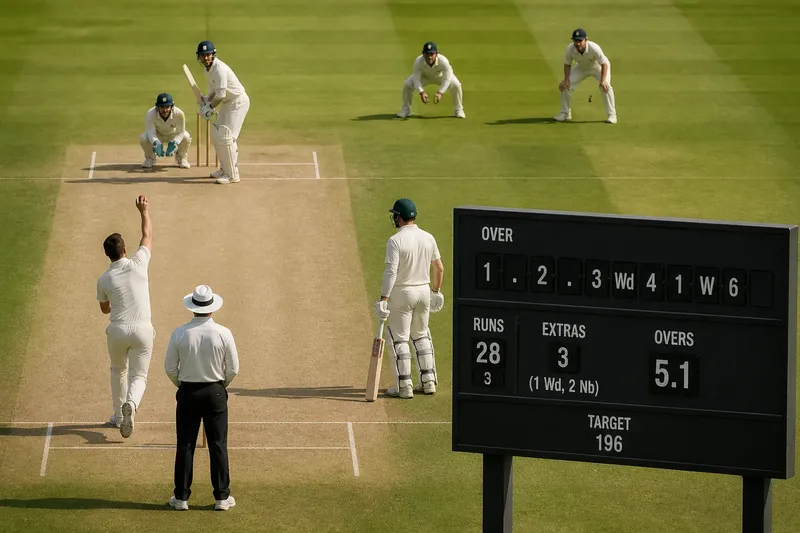
- Check overs used alongside runs scored in limited-overs cricket. If the batting side has used many overs for few runs, expect it to consider a faster scoring approach; if it has scored freely, it may have more room to protect wickets.
- Check how many wickets remain. If few are left, expect the batting side to weigh survival more heavily; if many remain, it may have more options for taking scoring risks.
- After an interruption, check the revised overs and target. If either has changed, judge the chase against the new conditions; if neither has changed, continue using the original target and allocation.
- Watch for a declaration or a change in tempo. If a declaration gives the opposition a target and time to bat, expect the bowling side to pursue wickets; if the innings continues, the batting side is still adding to its position.
- Check whether the match is being played under multi-day or limited-overs conditions. If it is multi-day cricket, track scheduled time and innings; if it is limited-overs cricket, track the over allocation and any revised target.
Say you are following an invented multi-day match: Team A leads, Team B has not yet begun its final innings, and the last scheduled day is underway. First, note the lead and remaining play; then check how many wickets Team A needs and whether Team B has enough time to bat. If Team A declares, record the target and the time left; if it keeps batting, the lead grows while the bowling opportunity shrinks. The observable tradeoff is whether the added runs seem more valuable than the time surrendered.
Cricket’s changing clock is not just a shift from long matches to short ones. It changes what a side can afford to delay. Pair the score with the time or overs left, and a declaration, a cautious over, or a late burst of boundaries becomes easier to read as part of one unfolding decision.